

Bathtub Painting: How Does Surface Material Change Preparation and Finish Selection?
A bathtub can look like a single, smooth surface, but that appearance often hides important material differences. Porcelain over cast iron, porcelain over steel, fiberglass, and acrylic do not respond to abrasion, primers, or finish systems in the same way. A coating that bonds well to one surface may struggle to bond to another if the base material has different hardness, flexibility, porosity, or wear history. That is why bathtub painting depends on substrate evaluation rather than color selection alone.
Gloss level, surface profile, repairs, cleaning history, primer compatibility, and finish selection all change when the underlying material changes. A worn porcelain-enamel tub may need a different evaluation than a flexible fiberglass unit with dulling or stress marks. The best-looking result starts before the finish is applied, with careful attention to what the bathtub is made of and what that material requires to accept a new coating properly.
Bathtub Surface Material Determines Preparation Requirements
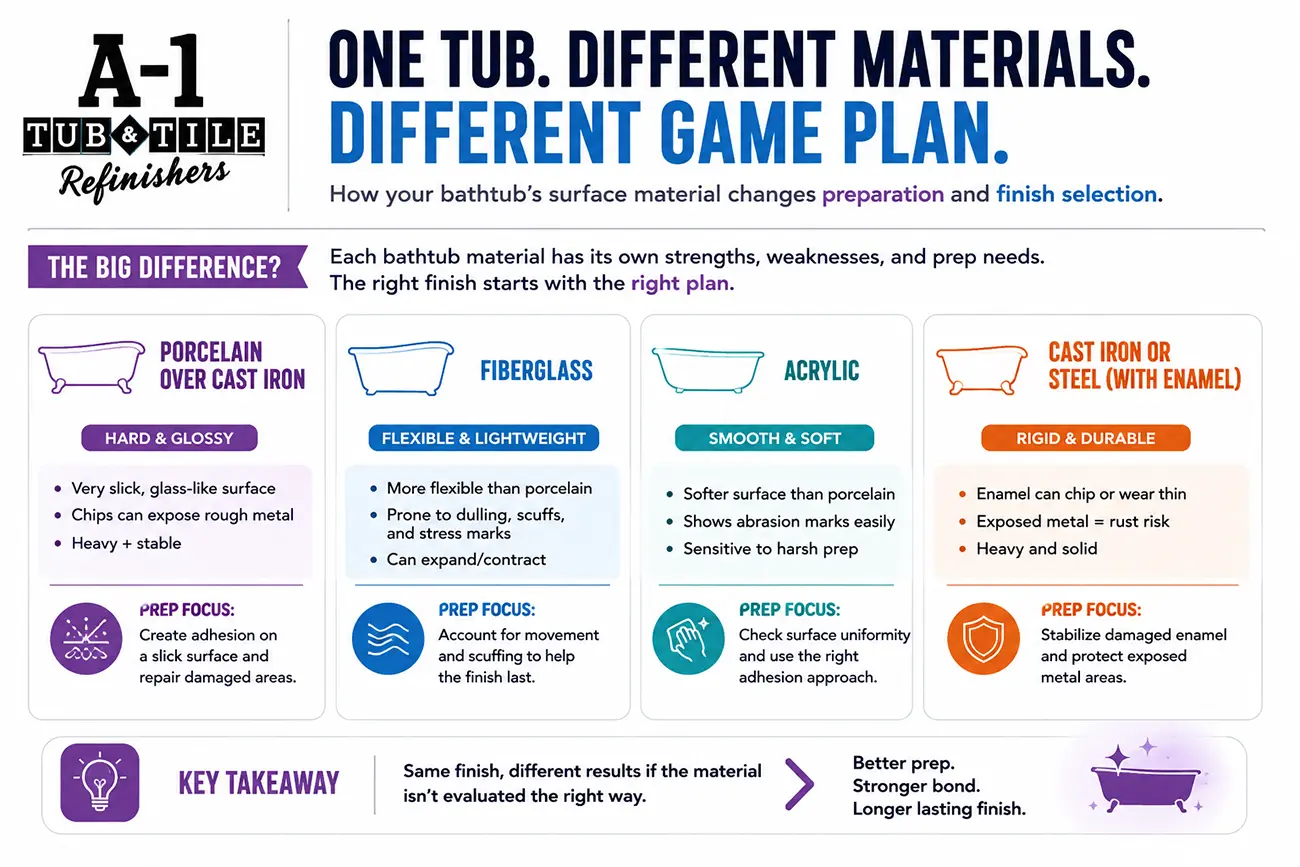
Surface material affects how bathtub painting should be evaluated, as each substrate responds differently to cleaning, abrasion, bonding, and wear. A porcelain-enamel tub usually presents a hard, glass-like surface, so the main challenge is creating reliable adhesion over a slick, dense finish while addressing chips or worn-through areas. Fiberglass and acrylic behave differently because they can flex, scuff, dull, or develop stress-related wear patterns that affect how evenly a new finish bonds. Cast iron and steel add another layer of evaluation because damaged enamel may expose a rigid metal base beneath the visible surface.
| Bathtub material | Common surface behavior | Preparation priority |
| Porcelain enamel | Very hard, glossy, low surface profile | Promote adhesion on a dense surface and stabilize worn areas |
| Fiberglass | Lighter, more flexible, prone to dulling and texture changes | Account for movement, scuffing, and uneven wear |
| Acrylic | Smooth, softer than porcelain, often sensitive to prior abrasion marks | Evaluate surface uniformity and bonding behavior |
| Cast iron or steel with enamel | Rigid base with possible chips exposing underlying metal | Address damaged enamel zones before finish selection |
These differences matter because product claims can sound broader than the surfaces they actually address. A finish described as durable in general terms still has to be judged against the tub’s substrate, age, damage pattern, and use environment. Without substrate-specific evaluation, the same coating conversation may be applied to materials that behave very differently under moisture, cleaning, and repeated use. Bathtub painting works best when preparation is treated as a material-specific decision rather than a generic pre-finish routine.
Finish Selection Depends on Substrate and Use Conditions
The finish selection in bathtub painting cannot be separated from the underlying material or from how the fixture is used after refinishing. A glossy white surface may be the visual goal, but porcelain enamel, fiberglass, acrylic, cast iron, and steel do not all accept coatings in the same way. The finish also must be considered in relation to movement, hardness, exposed damage, prior repairs, and routine cleaning exposure. A coating decision that ignores these variables may create a surface that looks uniform at first but is not well matched to the tub’s actual conditions.
- Rigid surfaces: Porcelain-coated cast iron and steel often require attention to slickness, chips, exposed metal, and edge wear before finish compatibility can be judged.
- Flexible surfaces: Fiberglass and acrylic involve movement, stress points, and previous surface fatigue that can influence coating behavior.
- High-use areas: Bottoms, drain zones, ledges, and shampoo-contact areas experience different wear than vertical walls.
- Cleaning exposure: Finish selection must be considered in relation to routine maintenance expectations and likely abrasion.
A finish that performs well on a hard, stable tub may not be the right match for a lighter synthetic unit that flexes during use. Moisture patterns also affect selection because standing water, frequent bathing, and repeated cleaning can stress weak surface preparation or an incompatible coating choice. The practical evaluation treats the bathtub as a complete surface environment, not as a blank object waiting for color. That approach helps connect the visible finish to the less visible conditions that determine whether it can perform consistently.
General coating language can be useful for describing appearance, but it is less useful when it fails to distinguish between substrates. Bathtub painting decisions should account for whether a claim applies to porcelain enamel, fiberglass, acrylic, cast iron, steel, or only a limited set of conditions. Broad durability statements are not the same as substrate-specific performance information. The more varied the tub materials, the more important it becomes to separate surface appearance from coating compatibility.
Why Material-specific Preparation Determines the Result
In successful bathtub painting, the finish is never the true starting point. The real starting point is identifying whether the tub is porcelain enamel, fiberglass, acrylic, cast iron, steel, or another surface that changes preparation needs. Each material responds differently to cleaning history, wear, gloss loss, prior coatings, chips, flex, and moisture exposure. Adhesion planning, repair evaluation, primer compatibility, and topcoat choice therefore have to work as one surface system rather than as separate decisions.
A tub that looks smooth can still reject the wrong coating strategy if its substrate and condition are misunderstood. Porcelain may appear intact while still carrying slick areas, mineral residue, or chipped enamel edges that complicate bonding. Fiberglass may look acceptable from a distance while showing dulling, flex-related fatigue, or uneven texture up close. Acrylic may present a clean surface but still require careful compatibility evaluation because it is softer than porcelain and can show previous abrasion patterns more readily.
The difference between a short-lived cosmetic refresh and a more dependable refinished surface often comes down to what was recognized before any finish was selected. Bathtub painting succeeds when substrate identification, condition assessment, repair planning, adhesion preparation, primer compatibility, and finish selection are aligned with the actual material and use environment. Color and gloss matter, but they are only the visible end of a much larger surface decision. When the material drives the choice of preparation and finish, the final result has a stronger foundation.